 Skip to main content
How energy storage systems operate in the modern market
In the previous article in our series, we explained how such a system works. Now let’s take it a step further and look at how BESS can operate in today’s energy market and what roles it can play.
Battery systems are divided into front-of-the-meter (FTM) and behind-the-meter (BTM) systems, depending on where they are installed and the role they are intended to perform. The latter also include residential battery systems (from the operator’s perspective, they are behind the meter, forming part of the electrical installation on the owner’s side, for example that of a homeowner). The figure below helps explain the difference.
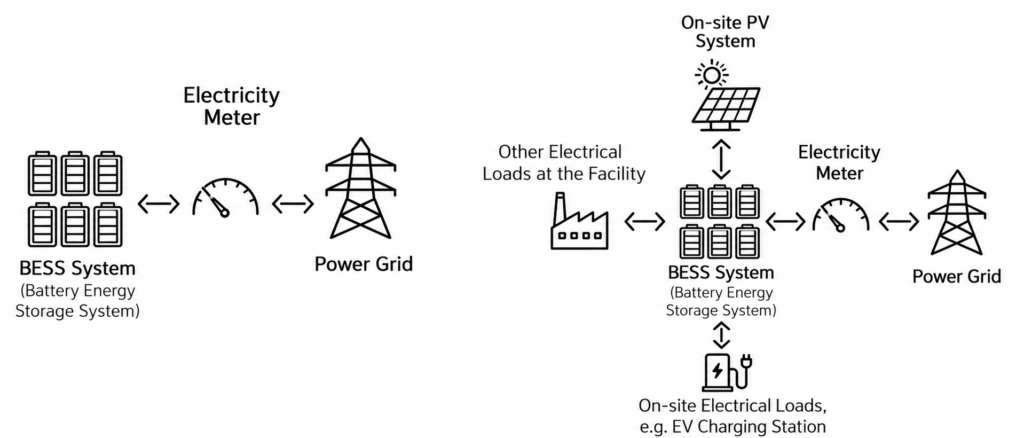
Figure 1. a) Front-of-the-meter (FTM) and b) behind-the-meter (BTM) BESS systems.
In industrial settings, BTM BESS systems are mainly used to:
- Maximise self-consumption from renewable energy sources (RES, if the home, plant, company or farm has such sources): When combined with a local photovoltaic installation, a BTM BESS stores surplus energy generated during the day or, for example, at weekends, rather than feeding it back into the grid at unfavourable market prices or simply not generating that energy at all. The stored energy is used when needed, for example in the evening or the following day.
- Reduce peak demand charges (peak shaving): This is one of the key roles in industry. A BTM BESS discharges during periods of the highest (peak) electricity consumption by a company or plant. This reduces the maximum power drawn from the grid (the BESS and the grid jointly supply the plant’s needs, so the amount drawn from the grid is reduced by the amount supplied by the BESS). This can reduce fixed distribution charges or simply keep consumption within the contracted capacity agreed with the distribution system operator, avoiding penalties.
- Manage electricity prices (energy arbitrage/load shifting, for companies that choose electricity purchase contracts with dynamic tariffs): The system charges the batteries when electricity from the grid is cheapest (e.g. during off-peak night-time tariffs or periods of market oversupply) and supplies energy to the facility when electricity prices rise sharply.
- Provide emergency power and business continuity: A BESS operates like an advanced, large-scale UPS system. In the event of an external grid failure, it protects the company against costly production downtime and damage to machinery.
- Compensate for reactive power: Modern BESS systems allow power quality to be controlled and can therefore act as a source or load with specified characteristics. For companies with a significant inductive component (e.g. a large number of electric drives) or capacitive component (e.g. data centres or large facilities), this function is important for reducing electricity costs.
These are only some of the potential applications, but they include the most important functions offered by behind-the-meter BESS systems. One of the latest trends is the use of BTM BESS at electric vehicle fast-charging stations. In this case, the main objectives are also usually peak shaving and the ability to charge several cars simultaneously at high power. Such charging does not take long, but the power demand is substantial. BESS can eliminate the need to sign a contract with the operator for the station’s full capacity or enable a station to be built at a location where the required peak power is not available at the connection point. The second argument is price management.
These characteristics make BESS increasingly attractive to many investors. According to the Energy Market Agency (ARE), the total energy storage capacity in Poland reached 8.85 GWh (equivalent to our largest power station in Bełchatów operating at full capacity for almost two hours). According to the agency’s data from August 2026, there are 114,418 electricity storage installations operating in Poland, most of them in prosumer systems (112,465 units). There are 1,948 industrial storage installations (medium-sized, with capacities of 0.05–10 MW) in Poland, which is a considerable number. However, their combined power and energy capacity suggest that these are relatively small installations. The data are presented in the table below.
Summary of the data is presented in the table below.
| Segment | Number of installations [units] | Installed capacity [MW] | Energy storage capacity [MWh] |
| Micro-installations (<0.05 MW) | 112,465 | 594.34 | 1,415.54 |
| Medium-sized installations (0.05–10 MW) | 1,948 | 43.17 | 99.43 |
| Large-scale installations (>10 MW) | 5 | 1,699.59 | 7,339 |
Table 1. Electricity storage installations in Poland (source: Energy Market Agency S.A.).
The five large energy storage systems mentioned in the ARE report are pumped-storage power stations (including the largest, at Żarnowiec, with 716 MW/3.6 GWh). The small number of BESS systems in this segment may seem surprising, but we should remember that 1 GW/4 GWh of BESS capacity is awaiting grid connection conditions, acceptance procedures and so on in 2026 alone. According to the National Energy and Climate Plan adopted by the Council of Ministers (a document prepared by the Ministry of Energy), Poland is expected to have approximately 6 GW of installed battery storage power capacity by 2030 under the ambitious WAM (With Additional Measures) scenario, presumably involving support mechanisms.
Let us now look at front-of-the-meter (FTM) systems, i.e. large BESS installations that should provide services and enable interaction with both the distribution and transmission systems. Unlike domestic or behind-the-meter BTM systems, FTM installations are not assigned to a specific electricity consumer or factory. Their purpose is to stabilise the electricity system as a whole and generate revenue from energy trading on a large scale.
There are also many operational possibilities here, but let us focus on the key ones:
- Market arbitrage: The storage system charges from the grid when electricity is cheap (e.g. at sunny midday periods thanks to photovoltaics or on windy nights thanks to wind turbines), when prices are attractive and may even be negative. It then feeds energy back into the grid during periods of highest demand (usually in the evening), when prices reach their highest levels.
- Participation in the Capacity Market: The storage owner receives a fixed payment from the grid operator simply for being ready to supply energy at critical moments (so-called stress events), when reserve capacity is needed.
- Provision of ancillary and frequency regulation services (the balancing services market): This is the most technically advanced role and often the most important revenue stream. The storage system responds to grid frequency fluctuations within fractions of a second (FCR and aFRR functions), stabilising grid parameters and preventing blackout-type failures (it is highly likely that the malfunctioning of such mechanisms, combined with several other operator errors, was at the root of the blackout in Spain in April 2025).
How do these operational opportunities work in the market? Market arbitrage seems fairly easy to understand, although from the perspective of control and revenue generation, it is by no means a simple mechanism. The electricity exchange operates in 15-minute intervals, so prices change very dynamically. In addition, every battery charging and discharging cycle brings us closer to the cycle limit specified in the warranty conditions. The number of cycles must therefore be managed sensibly. Making money from energy trading alone is a considerable challenge.
As for securing reserve capacity, this system in Poland is managed by Polskie Sieci Elektroenergetyczne (PSE), under the supervision of the President of the Energy Regulatory Office (URE). The main capacity auctions are held well in advance. In December 2025, the main auction for reserves for 2030 was concluded (Notice No. 1/2026 from the President of the Energy Regulatory Office regarding the announcement of the final results of the main auction for the 2030 delivery year). Almost 6.9 GW of reserve capacity was contracted across 198 units, including 33 foreign units. The price was PLN 465.02/kW/year.
Supplementary auctions also take place during a given year. For example, an auction for 2027 is scheduled for September 2026. The cost of providing reserves is ultimately passed on to consumers through the so-called capacity charge (visible on electricity bills).
So, if we contracted an entire 100 MW BESS system in the auction for 2030, we would receive PLN 46,502,000 per year. Impressive! But we can no longer win that auction, and there are still more than three years until 2030. The final and, at the time of writing, most important “product” that can be offered on the market is frequency stabilisation services, known as balancing services. As this is a fairly complex mechanism and service, I will devote more attention to it.
Balancing services market
In our first article, we drew attention to the complexity of electricity systems and the need to balance them. The transmission system operator (in Poland, this is straightforward, as there is only one such operator, PSE) continuously monitors the situation, paying particular attention to two parameters: frequency and voltage in the system.
In the simplest terms, when electricity demand begins to rise and no new sources of supply become available, the frequency starts to fall. This can happen for many reasons: large consumers or many smaller consumers may connect to the system, one of the major loads may significantly increase its power consumption, or an important electricity producer may disconnect from the system (e.g. due to a failure or cloud cover over a large photovoltaic farm).
This sensitive mechanism also works in the opposite direction: if there is an oversupply of electricity generation in the system and insufficient demand, the frequency begins to rise.
The operator monitors this frequency very carefully. In Europe, we use 50 Hz, so the operator will respond if the frequency falls to 49.99 Hz or exceeds 50.01 Hz. The operator will use the full contracted capacity when the frequency falls below 49.8 Hz or rises above 50.2 Hz. In the context of this article and BESS services, voltage is not quite as important (locally, it indicates the reactive power balance and the condition of the transmission network).
How can the transmission system operator protect against system destabilisation? The answer is simple: reserves must be secured. This means guaranteeing reserve capacity for the provision of balancing services, rather than simply for electricity generation. It involves maintaining a dynamic balance in the system by securing reserves both “upwards” (having units ready to supply additional energy when there is a shortage) and “downwards” (the ability to reduce generation or use surplus energy for charging). This is not a cheap process. Every year, PSE spends more than PLN 2 billion on it. The operator specifies whether an upward or downward service is required and which particular service is needed. There are several such services: FCR, aFRR, mFRR and RR.
These stand for:
- Frequency Containment Reserve (FCR): Also known as primary frequency control.
- Automatic Frequency Restoration Reserve (aFRR): Also known as secondary frequency control.
- Directly activated manual Frequency Restoration Reserve (mFRRd): Also known as tertiary frequency control.
- Replacement Reserve (RR): Each of these services is provided separately in the upward and downward directions.
Their most important characteristics are summarised below.
| Mechanism/Feature | FCR (Frequency Containment Reserve) | aFRR (automatic Frequency Restoration Reserve) | mFRR (manual Frequency Restoration Reserve) | RR (Replacement Reserve) |
| Activation time | 30 s | 5 min | 12.5 min | 30 min |
| Operation | The local frequency controller automatically activates the resource. For a BESS, this operates symmetrically in both directions: upward (energy delivery) and downward (energy consumption or reduced energy production). | Primary stabilization, with upward and downward regulation provided separately. | Manually activated by the system operator, with upward and downward regulation provided separately. | Replacement resources used to maintain system stability over a longer time horizon. |
| Is it attractive for BESS? | YES | YES | MODERATELY | NO |
| Activation method | Automatically activated by the controller when the frequency deviates by ±0.01 Hz. | Automatically activated by the transmission system operator and local control systems. | Manually activated by the operator or dispatcher. | Scheduled activation; a long-duration reserve resource. |
Table 2. Characteristics of different balancing mechanisms.
As we can see, different balancing services must support the operator not only by providing contracted capacity but also by responding within a specified time.
Of course, the operator also purchases these services separately, for specific periods and with an indication of the upward or downward direction (except for FCR, which is a symmetrical service). Four-hour time slots are standard, although there is already discussion about moving towards the electricity market’s 15-minute intervals. Due to the technological limitations of other solutions, BESS systems have an important role to play here. They are fast enough to provide FCR and aFRR services (the remaining balancing services can be provided by conventional resources and renewable energy sources). They also allow energy to flow in both directions, enabling both upward and downward regulation.
Current prices for providing aFRR services are approximately PLN 180/MW/h for upward regulation and approximately PLN 140/MW/h for downward regulation. Therefore, if I win an auction to provide upward aFRR services for four hours, using a 100 MW BESS system, I can expect to receive PLN 56,000. This applies regardless of whether the operator actually uses that capacity, because the operator has reserved it. This is known as a “capacity” service, securing balancing capacity. If the operator uses this capacity, as the service provider I will issue another invoice, this time for the energy itself. I must obtain the price for that energy on the balancing energy market, where I am required to submit an offer for the contracted capacity that I previously secured. I have become (or rather, my BESS system has become, and has been assigned the relevant identifier) a Balancing Service Provider (DUB).
Of course, entering this market is not easy. I must complete a complex qualification process, integrate with the operator’s systems and meet other requirements.
How does the balancing services market work?
How does this market work in practice? Let’s start by explaining who a DUB is. According to the definition on the PSE website: “A Balancing Service Provider (DUB) is an electricity market participant that supplies balancing energy and maintains balancing capacity for the Transmission System Operator.” If we are a DUB, we can therefore participate in auctions for providing balancing services to the transmission system operator (PSE), offering our available capacity as capacity reserved for balancing services. The market itself operates through auctions. PSE holds auctions on its balancing services platform, separately for “capacity”, meaning the reservation of capacity itself, and for the energy that may be needed if the operator decides to use it. Once I have qualified as a DUB, I can submit an offer on the capacity market for a specific time slot (at least one hour), a specific balancing unit (one of my BESS systems that has already received its identifier as a DUB) and a specified rate per reserved MW/h.
The operator forecasts its requirements for balancing services and selects the most advantageous offers.
Below is a graphical example of an auction result, followed by an explanation.

Figure 2. Example of the outcome of an auction for balancing services.
In our example, four bidders participated in an auction for balancing services, including me as a BESS operator qualified as a DUB. The operator needs to reserve the balancing capacity indicated by the dashed line for upward aFRR services (more power in the system). Each auction participant (DUB) proposed a price per megawatt for each hour of available balancing capacity reserved during that time slot. The unit is therefore PLN/MW/h. The operator closed the auction. The offer from provider DUB 1 was successful. My offer, as a DUB, was somewhere in the middle of the price range, and provider DUB 3 also qualified. We will all receive an offer to reserve our declared capacity for the declared period at the rate offered by provider DUB 3 (pay-as-cleared). DUB 3 will receive an offer, but not for the full capacity it offered, as this is not necessary. Bidder DUB 4 will earn nothing today for capacity reservation alone because its price was too high. However, if I have won the auction (as in our example), I must reserve that capacity for the required service during the specified time slot and be ready to provide the service. The operator has the right to request it if the situation in the system requires it.
This means that I will have to submit an offer on the balancing energy market, specifying a price for each MWh. If the operator requests this capacity and I fail to fulfil my obligation (because I do not submit an energy offer or ultimately fail to deliver the energy for another reason), penalties will be imposed. To summarise this rather complex mechanism: I participate in an auction to secure capacity (a “capacity” reservation priced in PLN/MW/h). If my offer is among the successful bids, I receive the capacity reservation rate at which the auction cleared. I must then submit an offer for the balancing energy itself (if it is ultimately needed, priced in PLN/MWh delivered), at a rate that I determine myself. The operator will again close the auction, selecting the final accepted offer in that auction and settling all bidders at that rate. I can therefore use my price per MWh to influence the likelihood of my offer actually being activated and, for example, limit the number of charging and discharging cycles of my system.
Once I have won a capacity auction and there is a need to use my energy at the proposed price per MWh, it is better to fulfil the obligation partially than not at all (for example, because of technical difficulties, which will also need to be explained). Even if I am forced to provide the service using another resource I own, rather than the one specified in my offer, I will have to explain this. In the case of mFRR and RR services, conventional generating units and renewable energy sources usually offer prices attractive enough that competing with BESS systems in these markets currently makes little sense.
As the number of distributed energy sources grows, so does the need to digitalise energy systems. The BESS battery system itself requires access to large amounts of real-time data and an intelligent operational platform that not only supports submitting different offers in different markets (energy and balancing markets) but also enables forecasting of the power and availability of my installation for different services in the future. A good BESS management platform (often referred to as an Energy Management System, or EMS) will also support the use of technological innovations such as advanced reporting, availability estimation, automatic execution of operating schedules, predictive maintenance management and artificial intelligence. It is also necessary to build an infrastructure capable of handling huge volumes of data, including historical information on energy consumption, the number of cycles and the condition of battery cells, in order to make more accurate forecasts of installation availability and monitor compliance with warranty conditions.
